

Why Grease Buildup in Exhaust Hoods Is a Serious Fire Hazard?
In a busy restaurant, it is easy to treat the hood as “just ventilation,” but grease does not see it that way. Grease is fuel, and when it collects inside the hood, ducts, and roof fan, it creates the exact conditions that allow a small flare-up to become a fast-moving incident. That is why the topic of kitchen exhaust grease fire hazard matters to every owner, manager, and chef who wants to protect staff, guests, and the business itself.
At The Kitchen Exhaust, we see the real-world pattern behind kitchen exhaust grease fire hazard situations: kitchens get busy, cleaning gets delayed, filters get clogged, grease bypass increases, and deposits build where no one can see them. Then one night, a flare from a burner or a sudden grease flash ignites deposits in the hood or duct. This guide explains why grease buildup is so dangerous, how fires spread through the exhaust path, what accelerates buildup, and how to prevent kitchen exhaust grease fire hazard risks with a practical maintenance plan. You will also see service names for internal linking later, including Commercial Hood Kitchen, Commercial Duct Work, Commercial Exhaust Fan, and Make Up Air / Fresh Air.
Grease Deposits Turn Your Exhaust Path Into Fuel Storage
Grease in a commercial kitchen is normal, but grease deposits inside an exhaust system are not harmless. When hot vapours rise from cooking equipment, they carry tiny grease particles that hit cooler metal surfaces inside the hood, filters, ductwork, and fan. Over time, those particles form a sticky film, then a thicker layer, especially in corners, seams, elbows, and fan housings. That buildup is the heart of the kitchen exhaust grease fire hazard problem because it creates a continuous fuel source spread across a long path that runs above your cook line and through the building.
Once deposits become thick enough, ignition can happen faster than most people expect. A quick flare on a grill, a pan fire, or a momentary flame roll can ignite residues near the hood opening. If deposits in the hood plenum or duct are present, fire can move beyond the appliance area. That is why a kitchen exhaust grease fire hazard is not only about what happens on the stove, it is about what is waiting above it.
Why Grease Ignites Faster In An Exhaust System
Inside the hood and duct, grease is often warmed repeatedly during service. It may not be visibly dripping, but it is continuously exposed to heat and airflow. That repeated heating can dry and harden deposits, making them more likely to ignite when exposed to flame. It can also create a situation where grease ignites and spreads through deposits in a chain reaction. This is one reason kitchen exhaust grease fire hazard incidents can escalate so quickly compared to a contained flare-up on the cook line.
Grease also tends to build in layers. The outer layer can look “not too bad,” while the hidden inner layers are thicker and more combustible. Without professional cleaning that reaches the full hood to roof path, you cannot reliably judge the real kitchen exhaust grease fire hazard level by looking at the hood face alone.
How Fire Can Travel From Hood To Duct To Roof Fan
A restaurant hood system is a path, and fire can use that path when deposits are present. The hood opening captures heat, smoke, and grease vapours, then ductwork carries them to the roof fan and out of the building. If the system is clean, that path is mostly metal and airflow. If it is coated with grease, that path becomes a line of combustible material. That is the practical definition of a kitchen exhaust grease fire hazard, because fire is not forced to stop at the appliance once fuel exists above it.
This is also why fire safety expectations often point to maintaining systems in accordance with NFPA 96 as referenced by the Ontario Fire Code. The purpose is not paperwork. The purpose is preventing grease accumulation in a system that can carry fire. When owners understand that, kitchen exhaust grease fire hazard prevention becomes a priority instead of an afterthought.
Why Duct Elbows And Roof Fans Are Common Hot Spots
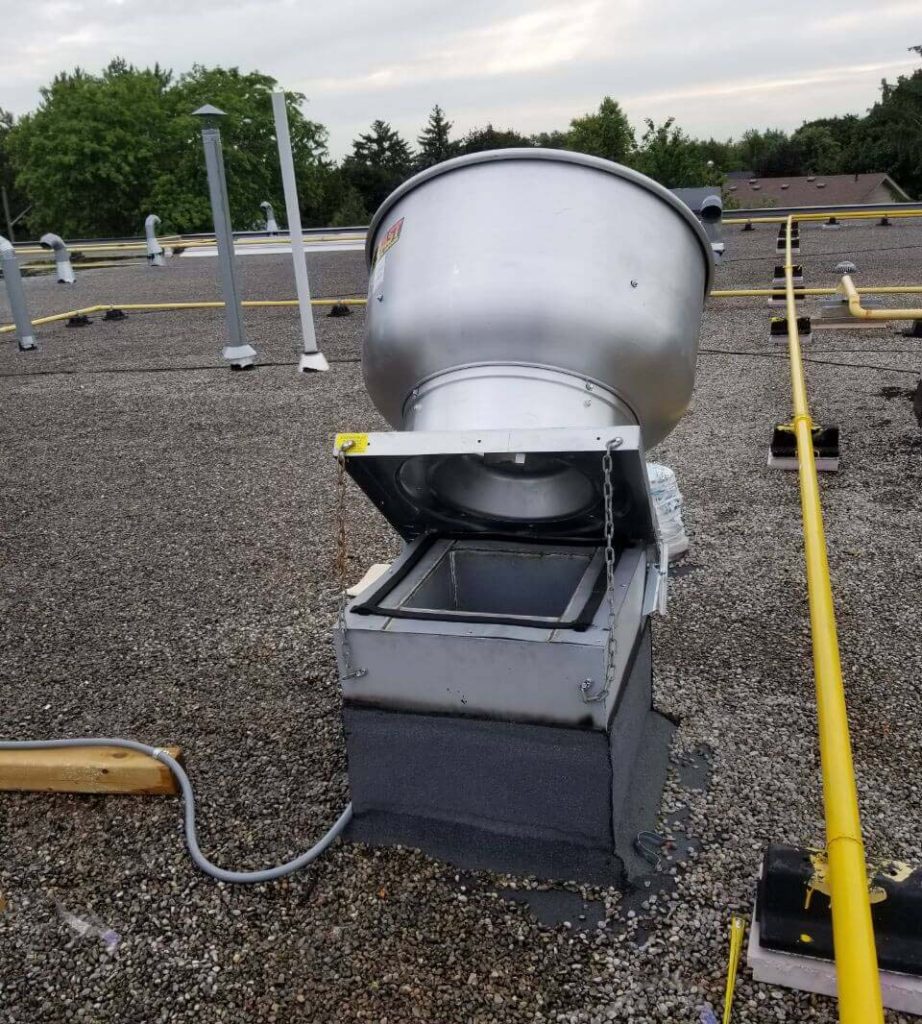
Grease does not deposit evenly. It tends to collect in elbows, transitions, and sections where airflow changes direction or slows. Roof fans often become hot spots because grease can coat blades and housing, and because moisture and residue collect in that area over time. If a fire reaches the fan section, it can intensify due to oxygen and airflow, and it can create rooftop hazards that are harder to control quickly. This is why Commercial Duct Work and Commercial Exhaust Fan service are critical parts of reducing kitchen exhaust grease fire hazard risk.
Even if your hood canopy looks clean, deposits in duct elbows or fan housings can remain. A real prevention plan addresses the full path: Commercial Hood Kitchen, duct interiors, and the roof fan assembly. Anything less leaves the kitchen exhaust grease fire hazard problem partially solved.
Why Grease Buildup Happens Faster In Some Restaurants
Not every restaurant builds grease at the same speed. Cooking type, volume, and operating hours change everything. A kitchen running heavy frying for 14 hours a day will build deposits far faster than a café that does light cooking for a few hours. Charbroiling, wok cooking, and high-heat sautéing can also increase grease-laden vapours, pushing buildup faster into filters and ductwork. That is why a responsible cleaning schedule is not guesswork, it is based on your real cooking load and the signs your system shows. If you ignore these factors, kitchen exhaust grease fire hazard risk rises even if the hood looks “fine” on the outside.
Air balance matters too. If your kitchen is negative and starved for replacement air, capture can become turbulent and less effective. When capture is weak, grease can spread into the kitchen environment and can also move differently through the hood and duct, sometimes increasing deposits in unexpected areas. This is where Make Up Air / Fresh Air plays a role in kitchen exhaust grease fire hazard prevention because stable airflow supports stable capture.
Filter Maintenance And Staff Habits That Accelerate Buildup
Filters are the first barrier, but they only work when they are cleaned and seated correctly. When filters are clogged, grease bypass increases and deposits form faster in the duct. When filters are misaligned, the bypass increases even more. If staff skip filter cleaning during busy weeks, deposits can accelerate quickly, and the kitchen exhaust grease fire hazard risk can jump in a short period.
Small habits compound. A kitchen that wipes the hood lip daily and degreases filters on schedule will typically have slower deposit growth compared to a kitchen that “gets to it when it gets to it.” The difference is not only cleanliness, it is safety. Good habits reduce kitchen exhaust grease fire hazard risk by reducing how much grease ever reaches the duct and fan.
Warning Signs That Your System Is Becoming A Fire Hazard
Restaurants rarely jump from “everything is fine” to “serious incident” without warning. Most kitchen exhaust grease fire hazard situations build up with signals that are easy to miss when you are focused on service. Smoke lingering under the hood, stronger greasy odors, filters clogging faster, and a louder roof fan are all signs that grease buildup is affecting performance. Visible residue on hood seams or splatter on nearby walls can also indicate capture is weakening and grease is spreading.
The key is to treat these signals as early warnings, not as normal restaurant life. When you respond early, cleaning is easier and the system returns to a safe baseline faster. When you delay, deposits get thicker and the kitchen exhaust grease fire hazard risk becomes harder to control.
Quick Kitchen Exhaust Grease Fire Hazard Checklist
- Smoke lingers under the hood longer than it used to
- Smoke spills past the hood edge during peak cooking
- Grease odor is stronger in the kitchen or near the exhaust discharge
- Filters look darker and clog faster between cleanings
- Grease drips from hood seams, corners, or filter tracks
- Roof fan sounds louder, rattles, or vibrates more
- The kitchen feels hotter and more humid during service
- Grease residue appears around duct access doors
- Doors become harder to open, suggesting pressure imbalance
- Staff complain about air quality and haze on the line
If you check multiple boxes, your kitchen exhaust grease fire hazard risk is likely increasing, and a professional inspection is the smartest next step.
The Real Cost Of Ignoring Grease Buildup
The worst cost is safety. A kitchen exhaust grease fire hazard can put staff and guests at risk, damage the building, and create long-term interruption for the business. Even a smaller event can trigger a fire department response, insurance claims, and mandatory corrective work before reopening. This is why prevention is always less expensive than reaction. Grease buildup is predictable, and predictable problems should be addressed before they become emergencies.
There is also the hidden cost of performance loss. Grease restriction increases resistance, which can reduce airflow and capture. Reduced capture means more heat, smoke, and odor in the kitchen, and more residue settling on surfaces. That increases daily cleaning time and makes sanitation harder. Over time, neglected systems also wear out faster. Fans run under greater strain, belts and bearings fail sooner, and the whole system becomes more expensive to maintain. The kitchen exhaust grease fire hazard is not only about fire, it is about the overall health of your kitchen operation.
Why “Just Cleaning The Hood Face” Does Not Reduce Risk Enough
Surface wiping helps appearance, but a kitchen exhaust grease fire hazard is mostly created by hidden deposits in the hood plenum, ductwork, and roof fan. If you only clean what you can see, deposits remain in the path where fire can travel. That is why a real plan includes Commercial Duct Work and Commercial Exhaust Fan cleaning along with Commercial Hood Kitchen service.
The goal is simple: remove the fuel from the path. Anything less keeps the fuel in place and keeps the kitchen exhaust grease fire hazard risk higher than it needs to be.
A Practical Prevention Plan That Reduces Fire Risk
The best prevention plan has three layers: daily and weekly staff routines, scheduled professional cleaning, and documentation that proves the system is being maintained. Daily routines include wiping accessible hood surfaces, emptying grease cups, and ensuring filters are seated correctly. Weekly routines often include proper filter degreasing and checking hood seams and corners for residue. These steps reduce how much grease enters the duct.
Professional cleaning is where deeper risk reduction happens. A full service should include hood interior, filters, duct interiors through access doors, and roof fan cleaning. The kitchen exhaust grease fire hazard risk drops most effectively when the full hood to roof path is restored to a clean baseline. A plan that repeats that process based on cooking load is how restaurants stay safer year-round.
The Role Of Make Up Air In Preventing Grease Spread
Makeup air is not just comfort. When replacement air is insufficient, kitchens go negative and airflow becomes unstable. That can disrupt capture and allow grease and smoke to spread. It can also make the roof fan work harder, which increases noise and strain. Improving Make Up Air / Fresh Air balance supports steadier capture, which helps keep the system cleaner between services and reduces kitchen exhaust grease fire hazard risk over time.
If your doors are hard to open, the hood spills smoke, or the fan gets louder, it is worth evaluating airflow balance alongside cleaning. A clean system plus balanced air is the strongest combination.
What Professional Cleaning Should Include
A proper professional service is not a quick spray and wipe. It starts with a walkthrough and containment setup to protect your kitchen. Then it includes filter removal, hood interior degreasing, scraping where needed, duct cleaning through access doors, and roof fan cleaning. It ends with a final wipe-down, cleanup, and a service report. This process is the most direct way to reduce kitchen exhaust grease fire hazard risk because it removes the deposits that act as fuel.
Documentation matters, too. Service reports help you prove maintenance during inspections and help you plan the next cleaning interval based on real condition. In Ontario, the Fire Code references maintaining commercial cooking exhaust and fire protection systems in accordance with NFPA 96, which is why recordkeeping and consistent maintenance are often expected in practice.
Why Frequency Should Be Based On Cooking Load
There is no one universal schedule that fits every restaurant. High-volume kitchens with heavy frying and long hours typically need more frequent cleaning than low-use kitchens. The smartest approach is inspection-based scheduling: inspect at intervals appropriate to your cooking type and clean before deposits become heavy. That keeps kitchen exhaust grease fire hazard risk lower and helps you avoid the surprise of “suddenly” needing urgent cleaning.
If you notice repeated warning signs returning quickly, it often means your schedule needs to tighten or your filter routines need improvement. A reputable contractor should help you adjust based on what they see in the system.
Why Choose The Kitchen Exhaust
Kitchen exhaust grease fire hazard prevention requires more than a one-time cleaning. It requires a consistent plan that addresses the full system and keeps it documented. The Kitchen Exhaust provides full service support across the entire path, connecting Commercial Hood Kitchen cleaning with Commercial Duct Work service and Commercial Exhaust Fan cleaning. We also evaluate Make Up Air / Fresh Air conditions when airflow issues are contributing to poor capture, faster buildup, or uncomfortable working conditions.
We understand restaurant operations and inspection realities. You need predictable scheduling, careful containment, thorough work, and reporting you can file and show quickly. Our goal is to reduce kitchen exhaust grease fire hazard risk by restoring safe airflow and removing the fuel deposits that put your kitchen at risk in the first place.
Protect Your Kitchen With A Proactive Cleaning Plan
Grease buildup in exhaust hoods is dangerous because it turns your ventilation path into a fuel source. When deposits collect in the hood, duct, and roof fan, a small flare-up can spread through grease along the exhaust path and escalate quickly. That is the real kitchen exhaust grease fire hazard, and it is preventable with routine inspection, full-system cleaning, and strong daily habits that keep filters and hood surfaces under control.
If you want to reduce kitchen exhaust grease fire hazard risk in your restaurant, The Kitchen Exhaust can help. We can service your Commercial Hood Kitchen system, clean your Commercial Duct Work, clean and inspect your Commercial Exhaust Fan, and evaluate Make Up Air / Fresh Air balance to support steadier capture. Contact The Kitchen Exhaust to schedule an assessment and build a maintenance plan that keeps your system safer, cleaner, and reliable year-round.
Frequently Asked Questions
- Why is kitchen exhaust grease fire hazard risk higher than most owners think?
Kitchen exhaust grease fire hazard risk is high because grease deposits can line the hood, duct, and fan, creating a continuous fuel path that can carry fire beyond the cooking line. - Can kitchen exhaust grease fire hazard issues happen even if the hood looks clean?
Yes. Kitchen exhaust grease fire hazard deposits often hide in duct elbows and roof fans, so a clean-looking hood face does not guarantee the full system is safe. - What is the fastest way to reduce kitchen exhaust grease fire hazard risk?
The fastest way to reduce kitchen exhaust grease fire hazard risk is professional hood to roof cleaning that includes hood interior, ductwork, and roof fan, plus a schedule based on cooking load. - Do filters prevent kitchen exhaust grease fire hazard buildup in ducts?
Filters help, but they do not stop all grease. If filters are dirty or misaligned, kitchen exhaust grease fire hazard buildup in ducts can accelerate quickly. - Does makeup air affect kitchen exhaust grease fire hazard risk?
Yes. Poor Make Up Air / Fresh Air balance can weaken capture and increase grease spread, which can increase kitchen exhaust grease fire hazard risk. - How do I know if kitchen exhaust grease fire hazard deposits are building up?
Common kitchen exhaust grease fire hazard warning signs include smoke lingering, stronger grease odor, faster filter clogging, loud fan noise, and visible residue on seams or access doors. - Can The Kitchen Exhaust help with kitchen exhaust grease fire hazard prevention?
Yes. The Kitchen Exhaust can clean and maintain Commercial Hood Kitchen, Commercial Duct Work, and Commercial Exhaust Fan components and evaluate Make Up Air / Fresh Air to help reduce kitchen exhaust grease fire hazard risk.